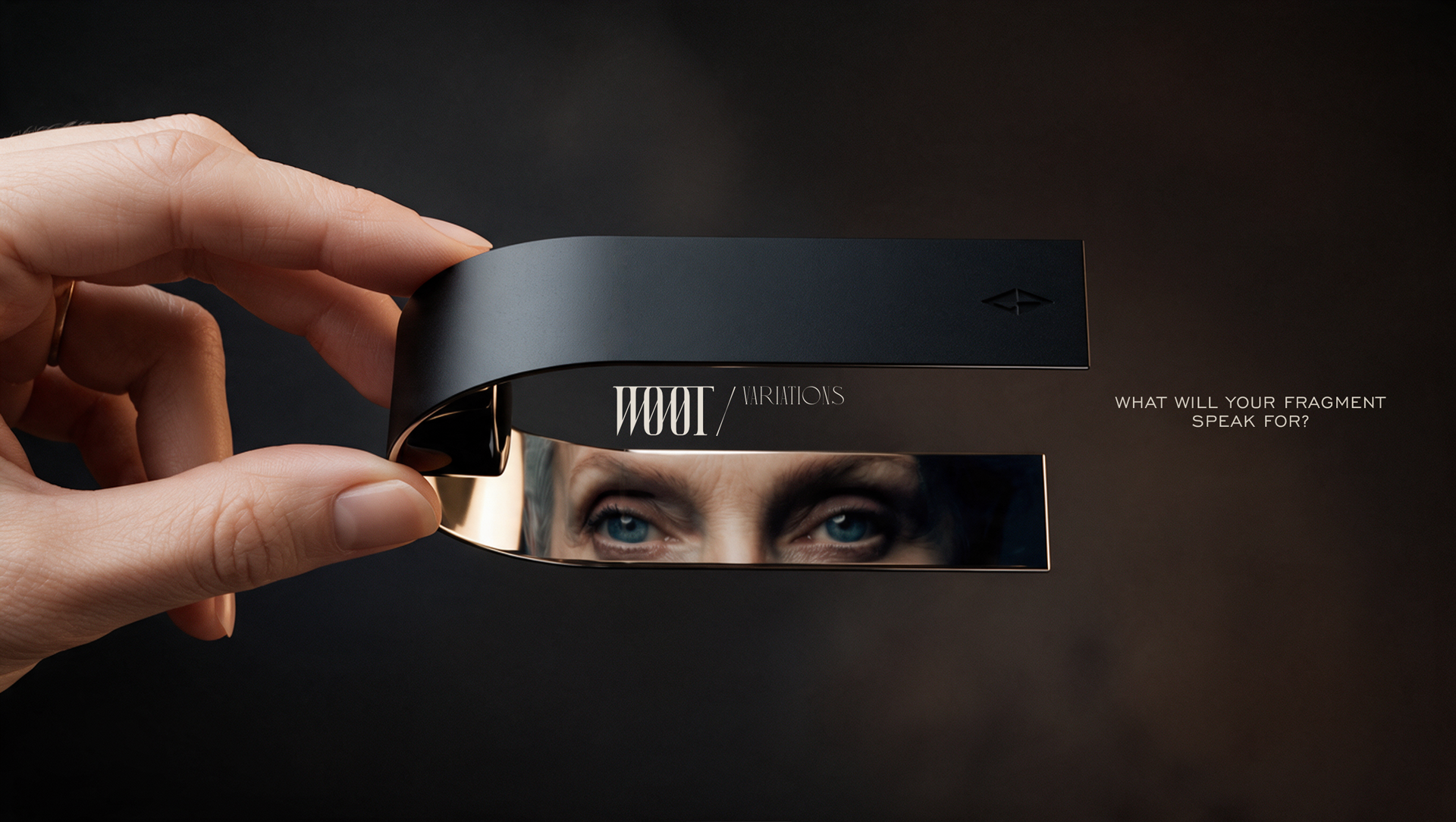

WOOT/VARIATIONS
An open invitation to the design community
THE VOWS OF YESTERYEARS
WOOT was born from a growing sense that the foundations of everything we once knew were slowly fading away. Decades of chasing after freedoms had blurred the boundaries between what was worth preserving and what was merely passing through, leaving something of our true selves behind.
We remembered the worlds we once imagined as dreamers, and wondered how to retrace our steps with the vigour of youth and the wisdom of a mature mind. Not to return to the past, but to recover what should never have been lost.
WOOT was envisioned as a guiding light, a transmission tower of sorts, broadcasting the principles we still believed in. A little thought control, if you will, in a world increasingly convinced that everything should be permitted, reconsidered or reinvented.
But once a message is transmitted, it no longer belongs entirely to its source. It travels, encounters other minds, and takes on forms its originator could never fully anticipate. The intent remained unchanged. Its expression was no longer singular.
And WOOT began to vary.
ITAQUE BY MINA KURASE


“It is not what you see, but what you make others see.”
When in doubt, it is often best to return to the beginning. Revisiting our origins offers the clarity and direction needed to continue with purpose. Itaque, composed by Bertrand Duchaufour, marks this point of return, a glimpse of what WOOT was, is and might still become.
At her studio in Antwerp, Japanese-Belgian artist Mina Kurase set out to hold two temporal states within Itaque: the reflections of possible versions of the future and the enduring imprint of the original intent. Her interpretation takes the form of white unicorns, repeated across the glass, their images shifting and multiplying through its transparent surfaces.
Working with cold-cured enamel and a natural pigment derived from finely powdered mollusc shells, Kurase creates an ethereal, almost spectral presence. The translucent white figures appear and dissolve across the glass, their delicate contours shifting through layers of reflection and refraction.
BEATUM BY FILIP ROUBAL


“We are what we repeatedly do. Excellence, then, is not an act but a habit.”
A nostalgic ode to the days when the pursuit of greatness was seen as a testament to human potential, a desire to reach ever higher rather than a reason for censure. Beatum, composed by Mark Buxton, reflects on the complexities of excellence, ambition and the convictions that drive us towards them.
Filip Roubal’s Beatum did not begin with a single clear decision. There were attempts, versions that almost worked, only to be reconsidered. Each carried its own weight, until the pursuit of excellence became a heavy cross to bear. The process was not linear, and it was not meant to be. Nothing of this kind arrives fully formed on the first try.
The original bottle was cut into four fragments along the axes of a Latin cross, then brought together again, leaving the traces of intervention deliberately exposed. Uneven seams, fine fractures and subtle displacements remain as evidence of what the glass has endured. Nothing is erased in the reconstruction. Every trace becomes inseparable from the object’s identity, bearing witness to its own history.
SOMNUS BY YANN VIRET


“The future belongs to those who believe in the beauty of their dreams.”
Only those who dare to dream can turn dreams into reality. True objects of desire are not simply offered; they must be discovered. Somnus, composed by David Chieze, explores the tension between our innate desires and the increasingly fluid principles through which we interpret them. A reminder of what genuine longing once felt like.
For Yann Viret, Somnus begins with desires that take shape before we can name them, small private signs from a time when even loss could still be exchanged for a promise. Some follow us into adulthood. Others are outgrown, surrendered, or never fulfilled. Becoming asks for something in return. What remains becomes part of our structure.
Working with mineral micro-enamels and his own multilayered formulations, the artist brings a collection of miniature symbols to the glass, each carrying a fragment of childhood memory. The cap’s pale, opalescent finish evokes natural tooth enamel, while a deliberately chipped tooth among the miniature figures introduces a more unsettling detail. That small fracture marks the painful cost of parting with something once held dear.
THE EXORDIUM
These first interpretations were never intended to define a collection or establish a visual language. They mark the beginning of something larger.
What began as an attempt to preserve and transmit certain convictions now finds its continuation in the hands of others. The original intent remains, while each new interpretation carries the message further, beyond the boundaries of its first expression.
WOOT/Variations is an invitation to artists across disciplines and borders to find something of their own in these ideas. To choose the message that resonates with them and give it form through their own vision, materials and techniques.
If one of these messages resonates with you, its next form is yours to define.
No prescribed technique. No predetermined aesthetic. No definitive interpretation.
THE WHOLE IS NEVER GIVEN.
 Simple Studio
 M&A CREATIVE AGENCY
 monther al omari
 Husain Studio
 JDO
 INTSIGN
 Agence des Coteaux
 Yaniv Vaknin
 AUN BRANDS
 houseoferas by Miti
 Just Design
 BREAK DESIGN
 Anamika
 Zialon Estudio
 ABC Design Communication
 Modern World Studio
 Jaehee Ha
 Intertype Studio