Closing the lid on waste: How cap design affects the recyclability of beauty packaging
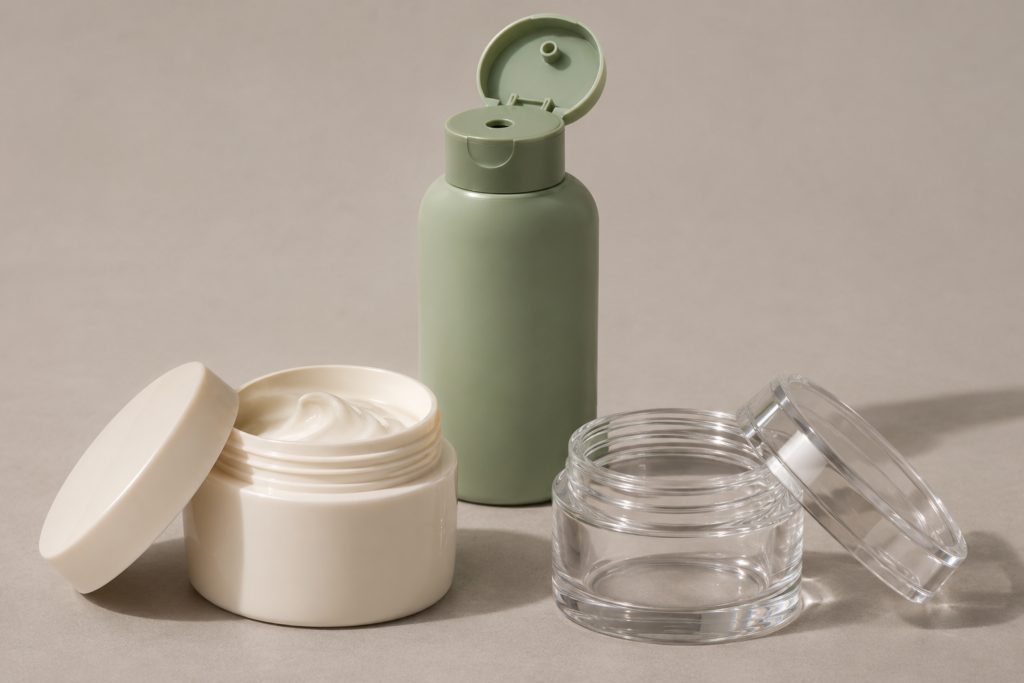
A glossy acrylic cap gives a face cream jar weight and shine. A polypropylene cap can offer a similar finish, but it feels lighter in the hand. For a beauty brand, that choice affects both how the jar feels to the customer and how easily the finished pack can be recycled.
The EU’s Packaging and Packaging Waste Regulation (PPWR) makes that a practical design question. Along with the cap itself, designers need to consider how its liner, seal and any metal parts will behave when the pack is sorted and recycled.
Do cosmetic caps have to stay attached?
No. Since 3 July 2024, the EU’s Single-Use Plastics Directive has required plastic caps to stay attached to certain beverage containers of up to three litres. Cream jars and shampoo bottles fall outside that requirement.
A beauty brand can still choose a hinged flip-top cap, as many do for shampoo bottles, to keep the cap attached during use.
Choosing between acrylic and polypropylene caps
Acrylic is used for cream and serum caps because it combines clarity, gloss and weight. In their 2025 guide, French industry bodies ELIPSO and FEBEA identify acrylic (PMMA) jars as unsuitable for recycling. Their assessment concerns the jar itself. For a cap fitted to a jar made from another material, the relevant question is how the two components will be sorted and recycled together.
Cosmetic closures made from polypropylene (PP) are available in glossy, matt or ribbed finishes and can be produced in custom colours. The harder quality to reproduce is acrylic’s weight. If that weight serves mainly to give the pack a premium feel, designers will need to consider how much material the cap needs to do its job.
How the PPWR assesses the whole pack
Under Regulation (EU) 2025/40 the cap counts towards the recyclability of the whole pack. If part of the cap cannot be recycled, it reduces the share of the pack that qualifies as recyclable. The regulation has applied since 12 August 2026, with its design requirements taking effect from 2030 or later.
Once those requirements apply, packs will receive a recyclability grade. Grade A requires at least 95 per cent of the pack to be recyclable, grade B at least 80 per cent and grade C at least 70 per cent. The requirement for packaging to be recycled at scale will apply from 2035 at the earliest.
Weight is a separate design consideration. From 2030, packaging weight and volume must be kept to the minimum needed for the pack to function. For a cream jar, that raises a practical question: how much material does the lid need to close securely and protect the product?
A separate requirement covers recycled content. Cosmetic packaging may qualify as contact-sensitive. For contact-sensitive cosmetic packaging made from plastics other than PET, the initial recycled-content target is 10 per cent and will apply from 2030 at the earliest. The target rises to 25 per cent in 2040. These percentages are calculated for each packaging type and format as an annual average per manufacturing plant.
The recycled-content requirement exempts plastic parts that account for less than 5 per cent of the pack’s weight, such as a lightweight cap on a heavy glass jar.
How to design a recyclable cap
Designing a closure for recycling starts with material choice and component count. Ideally, the cap is made from the same plastic family as the bottle or jar, such as the polyolefins PP and HDPE, with no parts in other materials. RecyClass, a cross-industry recyclability initiative, accepts PP caps on HDPE bottles up to 10 per cent by weight. According to the ELIPSO and FEBEA guide, metal springs, metal shells and balls disrupt the sorting and recycling process.
Four questions can help a team assess its closure options early in a sustainable packaging project.
- Material. Can the cap and container be recycled together in the intended recycling stream?
- Parts. Can a metal spring, shell or other component be removed or replaced without affecting how the closure works?
- Hinge. Would a hinged cap help prevent the closure from being lost during use?
- Seal. Can the seal be moulded into the cap using the same plastic, eliminating the need for a separate liner?


Comments
0 commentsLog in to comment or submit projects