

tochy: hand soap constructor that allows to personalize a daily-use product
For the target audience, the bathroom is as much an extension of their personality as their workspace, clothing, or accessories. People who care about their visual environment want even the most ordinary everyday objects to reflect their taste and mood.
Tochy is a customizable soap that transforms a familiar household item into a means of self-expression and everyday interaction.
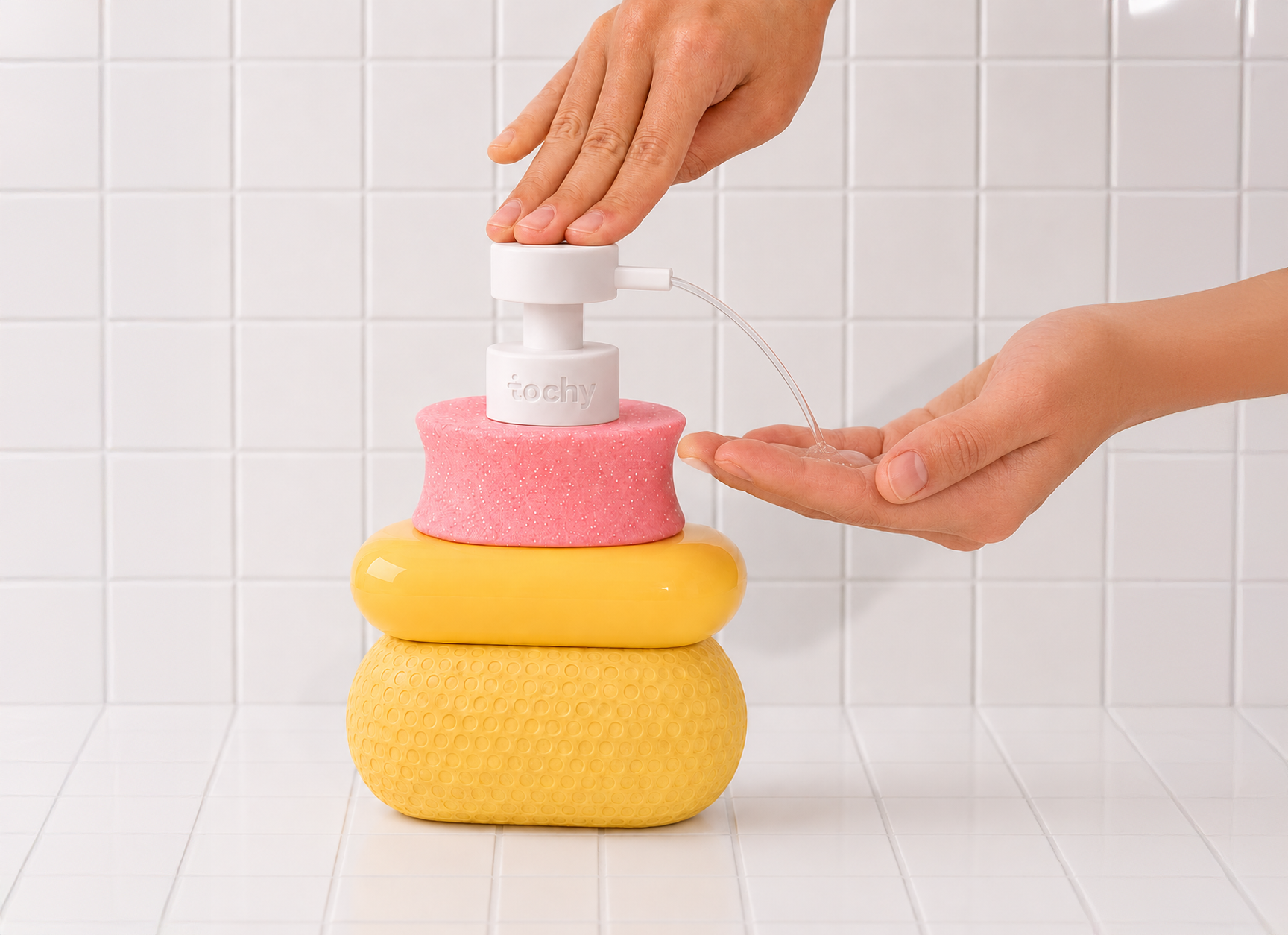
Tochy allows users to build their own soap container by choosing the color, shape, and texture of each component, creating a combination that perfectly suits both the individual and their interior. As their mood or living space changes, they can reassemble the container to match it.
Personalization goes beyond appearance. Handwashing is one of the most frequent daily routines, yet it is usually performed automatically, with little thought or emotion. Tochy redefines this experience through touch. Each component has its own unique shape and texture, making it satisfying to hold and interact with. Instead of simply using a bar of soap, people engage with an object they assembled themselves, one that feels personal and enjoyable in their hands.
This gives users the opportunity to create something uniquely their own and build an emotional connection with it. The pleasant tactile experience transforms a brief everyday routine into a small moment of enjoyment and mindfulness.
Thanks to its wide variety of forms and colors, the brand can naturally collaborate with companies from completely different industries.
Curator’s Insight
Most personal care packaging solves for shelf appeal once, at the point of purchase. This system solves for a different moment, the daily one, by treating the object as something to be rebuilt rather than simply owned.
The modularity works because each segment carries a distinct tactile signature, not just a different color. A speckled matte cylinder reads differently under the palm than a glossy dome or a dotted textured base, so swapping pieces changes how the object feels to use, not only how it looks on a shelf. That distinction matters, since color customization alone would only address display, while texture customization addresses the handwashing motion itself, which is the one interaction that repeats daily.
Stacking also does quiet functional work. The interlocking rings let each piece twist free and reattach in a new order, so reconfiguration takes seconds and requires no tools, which keeps the ritual from feeling like maintenance.
The larger principle: when a product invites personalization, the customizable variable should live in the same sense the object is actually used through, not just in how it’s seen. Visual choice alone rarely survives contact with a repeated physical routine.



 Natasha Spitsyna
 babyage
 GruppoSaida
 ahmedraoudgfx
 Hi estudio
 Nadezhda Gorelikova
 Studio Garces
 Brandsbylufo
 Rewot
Rewot alchimistestudioParis
 Asprey Creative
 kat bres
 Valérie Colace
 Atiq Alam
 Sara Communications
 David Hakobyan
 monther al omari
 Innovāt - Empowering Creative Innovation
 mmdesign
 Amjad Battal
 Hollóka Grafikai Műhely / Graphic Design Studio
 Palashcc
 ABC Design Communication
 ChrisSkarlatos
 Hedayat Hadavi
 Tia Nguyen