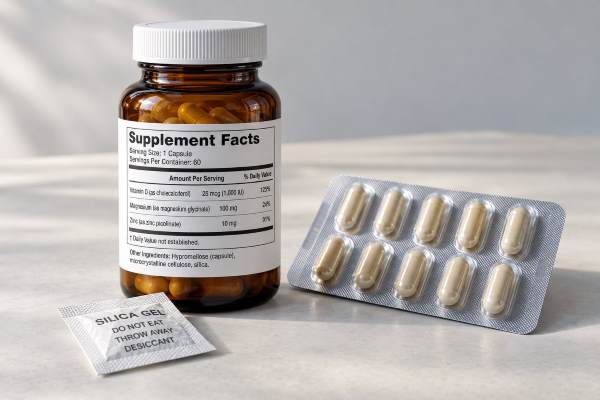


Effective packaging must do more than look appealing; it needs to protect products from light, moisture, and oxygen to preserve potency and stability. For packaging and design professionals, supplement packaging design is a critical step for new brands. Understanding barriers, closures, and regulatory requirements is vital for creating packaging that ensures both safety and compliance.
When entering the supplement market, new brands face a unique set of challenges relating to packaging design. The wrong material choices can result in compromised shelf life, ingredient degradation, or missed regulatory marks. Not only do exterior elements like branding matter, but custom supplement packaging decisions around materials and barrier properties play a direct role in product quality. Factors such as light exposure, humidity, and oxygen infiltration all threaten supplement integrity, demanding careful consideration of packaging formats, barrier materials, closures, and labels at every design stage.
Key environmental threats and suitable packaging formats
Design professionals must evaluate how environmental factors—particularly moisture, oxygen, and light—impact supplement stability. Each active ingredient may behave differently under adverse conditions. For example, probiotics and botanicals are highly sensitive to moisture, while omega-3 oils and vitamin C degrade in the presence of oxygen. Fat-soluble vitamins and certain plant extracts are vulnerable to both UV and visible light, making supplement packaging design choices around container opacity a concern for maintaining potency.
Deciding on the best packaging format starts with a close analysis of product needs. Bottles (such as PET or glass) can provide strong barrier protection for lipids or moisture-prone powders, especially when paired with UV-blocking tints or amber colors. Jars are often chosen for larger volumes or blends requiring desiccants. Pouches and stick packs excel when space efficiency and portion control matter, but these need engineered multilayer constructions to achieve appropriate moisture and oxygen resistance. Blister packs (usually foil-based) are a preferred choice for single-dose stability, especially for probiotics, owing to their outstanding protection from both oxygen and moisture.
Barrier materials, closures, and regulatory label requirements
The heart of packaging protection lies in barrier materials. Selecting the right polymers, foils, or multilayer films minimizes transmission of unwanted gases and light. Moisture Vapor Transmission Rate (MVTR) and Oxygen Transmission Rate (OTR) tests help measure a material’s effectiveness. For instance, an amber PET bottle offers improved UV resistance for light-sensitive extracts, while foil-laminated stick packs can address both oxygen and pinholing risks for powdered blends.
Closures should also be evaluated based on their ability to prevent leaks, contamination, and tampering. Induction seals, for example, can be specified for jars and bottles to prevent post-fill leakage and to give clear evidence of tampering. Child-resistant closures, like push-and-turn or squeeze-and-pop tops, are often mandatory, ensuring accidental access is prevented. Apart from mechanical function, closure liners must also be validated alongside primary packaging for compatibility and long-term sealing performance.
Labeling compliance is critical. The FDA requires all supplement labels to display a Supplement Facts panel, appropriate warning statements, and allow space for lot coding. Packaging design teams should account for legibility, contrast, and space constraints—especially on smaller bottles or compact blister packs. This often entails careful layout of artwork dielines and building in change-control procedures to manage regulatory updates for private label supplement packaging programs.
Choosing the right packaging partner for new brands
For new supplement brands, working with a knowledgeable packaging partner is essential to ensure all critical performance requirements are met. The best partners are those experienced with supplement-specific formats, regulatory expectations, and production-scale quality control. They not only advise on suitable containers and barriers based on product stability needs but also support in filling, sealing, and labeling in ways that align with manufacturing realities and branding objectives for custom supplement packaging.
Comprehensive supplement packaging services consider which packaging formats (such as PET bottles, foil stick packs, or clear jars) will best support both the supplement’s functional needs and the brand’s market positioning. These solutions also address detail-oriented workflow, artwork documentation, and change-control, all of which help prevent errors and ensure compliance from concept to shelf.
It is important for brands to clarify expectations around tamper-evident features and child-resistant options. For example, twist-off caps with induction liners provide visible tamper evidence, while blister packs require push-through resistance testing for safety. An effective packaging partner will also guide brands through FDA labeling requirements for dietary supplements, dieline planning, and the technical nuances of material compatibility, all while keeping projects on track for private label supplement packaging launches.
Pitfalls to avoid and real-world examples
Poor packaging design choices can lead to usability problems, compromised protection, or regulatory failures. Related nutrition projects, such as protein bars for GLP-1 users, show how tightly shelf appeal, product positioning, and practical pack information can sit together in a compact format. For example, selecting an excessively reinforced barrier may create opening difficulties for consumers or prevent recycling, while neglecting to test closures or induction seals may result in leakage or failed tamper-evidence. Design teams sometimes miss mandatory label elements like the Supplement Facts panel, particularly when adapting layouts across different formats, which can create compliance risks that spill into supplement packaging review cycles.
A strong example of an integrated approach is EVO Botanicals USA, a Hallandale Beach, Florida manufacturer that manages sourcing, filling, and labeling in-house. This model allows for close coordination between the materials selected, the production process, and the ultimate label design. For further details on in-house manufacturing expertise, consult evobotanicalsusa.com. New supplement brands that work jointly with technical partners from the outset can also align packaging timelines and quality checks with EVO Botanicals USA and avoid common missteps, driving successful product launches that combine protection, compliance, and stand-out shelf appeal.
 Guest Writer
 Agustina Bo
 paulaodisea
 IrinaNikatina2323
 SERIESNEMO
 Cupla Studio
 ZERO11
 VaryaDrebent
 hello ocean
 Yash Panchal
 Nina Patseva
 Modern Theory
 Dizen
 Ebbi
 monther al omari
 YNOT TONY Design Studio
 BOYA Printing
 NEV
 Andydesigns
 Armoder Arte y Diseño
 rufydesign
 Sti&Co Design
 Vijay Raj N | Brand Designer
 theabsurdcompany
 Hollóka Grafikai Műhely / Graphic Design Studio